
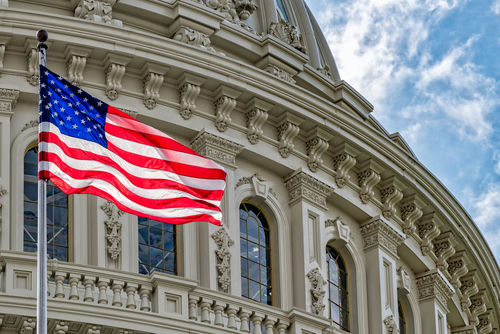
President Trump used the longest State of the Union in recent memory to lay down a simple challenge: secure the border, restore constitutional governance, and stop the Washington games that left Americans paying the price.
A record-length speech built around border enforcement and economic claims
President Donald J. Trump addressed a joint session of Congress on Feb. 24, 2026, delivering a State of the Union that lasted roughly 1 hour and 48 minutes. Trump opened with upbeat economic language and argued the country had moved from a period of crisis into what he called a “golden age of America.” He credited tariffs, domestic production, and policy changes after his 2024 return to the White House, while tying voter anxiety to prices, jobs, and border security.
Trump’s core domestic message stayed focused on illegal immigration and the mechanics of enforcement—exactly where many voters felt Washington failed during the prior administration. He argued for tougher border policy and pushed Congress to fully fund the Department of Homeland Security. The practical question now is what Congress will pass versus what remains campaign messaging: immigration enforcement can tighten through executive actions, but durable changes to statutes and appropriations still require votes, negotiations, and deadlines that don’t bend to slogans.
Election integrity messaging met immediate scrutiny from fact-checkers
Trump also leaned into election integrity and urged action on the SAVE AMERICA Act. That framing resonates with voters who watched institutions wobble under politicization, censorship fights, and shifting rules. At the same time, post-speech fact-checking disputed key parts of the rationale presented on illegal voting and the scale of related problems. For conservatives, the takeaway is straightforward: voter confidence matters, but lasting reforms need clean, provable facts—because weak claims give opponents an easy opening to dismiss commonsense safeguards.
Reporting after the address highlighted another tension: Trump’s pitch to the base versus the broader electorate heading into the 2026 midterms. Analysts observed he largely avoided unforced errors, yet the speech still underscored how sharply divided Washington remains. Trump’s coalition wants concrete results—lower costs, fewer illegal crossings, and less bureaucratic meddling—while Democrats signaled continued resistance and offered a formal response. The speech, then, functioned as both a governing roadmap and a turnout tool, with legislative pathways uncertain in the Senate.
🚨FULL SPEECH: Trump Speech TEARS into Biden Administration and Globalist Elites of the World Economic Forum for 40 Straight Minutes
Absolutely JAWDROPPING.
MUST WATCH. pic.twitter.com/bAJQXDsfeZ
— Benny Johnson (@bennyjohnson) January 23, 2025
?s=20
DHS funding and the limits of Washington brinkmanship
On homeland security, Trump argued for restoring full DHS funding and tied the request to operational readiness at the border. Subsequent coverage challenged some claims about whether funding fights would halt pay or create the most severe scenarios implied. Even with that dispute, the policy stakes are real: funding levels shape staffing, detention capacity, technology, and coordination with states. Conservatives concerned about government overreach often agree on one exception—border security is a constitutional responsibility—and they expect Congress to treat it like a core function, not a bargaining chip.
Foreign policy themes: Ukraine timelines, Iran warnings, and “ended wars” claims
Trump’s foreign policy segment emphasized efforts to end the Ukraine war and described heavy battlefield losses, while also signaling a preference for diplomacy with Iran paired with a firm stance against an Iranian nuclear weapon. He also referenced ending multiple wars, a claim that news coverage described as difficult to fully verify beyond the speech itself. The measurable point is that Trump used the SOTU to project urgency and leverage: he wants to define U.S. interests clearly, reduce open-ended commitments, and present outcomes as proof of competent leadership.
What to watch next: legislation, appropriations, and measurable outcomes
The clearest next step is not another speech—it’s paperwork and votes. If the White House wants the SAVE AMERICA Act or major border measures, the Senate math will determine what can clear, especially with thresholds that often require bipartisan support. If DHS funding becomes part of a larger budget confrontation, timelines and shutdown politics will matter as much as policy intent. Americans who are tired of inflation, disorder, and elite excuses should track concrete metrics: border encounters, removals, wage growth, and whether Congress actually delivers.
For supporters, the speech was a declaration that the post-Biden era will be judged by results, not narratives. For critics, it was a long, familiar argument that still leaves room for dispute on specific claims. Either way, Trump put his priorities on the record: enforce the border, push election-related legislation, demand DHS resources, and sell an “America First” economic reset. The country now moves from rhetoric to implementation—where constitutional limits, congressional power, and hard numbers will settle what really changed.
Sources:
Trump touts ‘golden age of America’ in longest-ever State of the Union speech
Fact check: State of the Union 2026
Trump State of the Union longest speech
Trump avoided self-harm in his State of the Union speech. He also missed self-help.
State of the Union 2026 live updates
President Donald J. Trump Delivers Monumental State of the Union Address; America Enters