
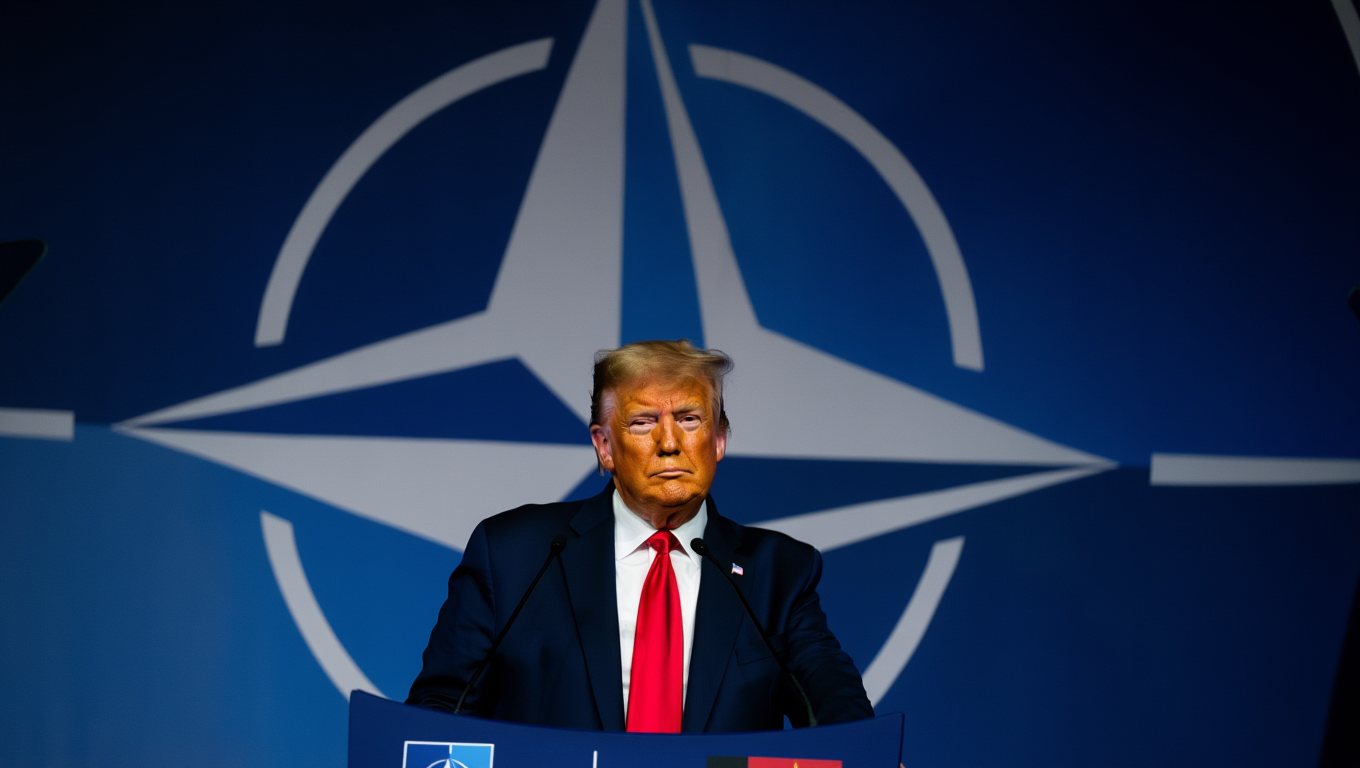
President Donald Trump announced Saturday he will impose a 10% tariff on all goods from eight NATO member nations beginning February 1, escalating tensions over his administration’s pursuit of Greenland. The economic penalties target countries that have deployed small military contingents to the Arctic territory in recent days.
The tariff announcement affects Denmark, Norway, Sweden, France, Germany, the United Kingdom, the Netherlands, and Finland. Trump stated the initial 10% rate will jump to 25% on June 1 and remain in place until the United States successfully purchases Greenland from Denmark.
In a social media post, Trump characterized the NATO allies’ military presence in Greenland as creating “a very dangerous situation for the Safety, Security, and Survival of our Planet.” He argued these nations are “playing this very dangerous game” and have introduced unsustainable risks to global stability.
Strategic Justification and Geopolitical Claims
The president reiterated his position that China and Russia pose imminent threats to Greenland, claiming Denmark lacks the capability to adequately defend the strategically important territory. Trump positioned himself as uniquely qualified to handle the complex geopolitical dynamics surrounding the Arctic region.
“Only the United States of America, under PRESIDENT DONALD J. TRUMP, can play in this game, and very successfully, at that!” he wrote in his Saturday post.
Greenland, an autonomous territory within the Kingdom of Denmark, has become a focal point of Trump’s foreign policy agenda. The island’s strategic location and natural resources have drawn increased international attention as Arctic shipping routes become more accessible due to climate change.
European Leaders Push Back Against Economic Coercion
The tariff threat prompted swift condemnation from targeted European leaders, who characterized Trump’s approach as unacceptable intimidation tactics that violate principles of national sovereignty and alliance cooperation.
French President Emmanuel Macron issued a particularly strong rebuke, stating that “no intimidation nor threat will influence us, neither in Ukraine, nor in Greenland, nor anywhere else in the world when we are confronted with such situations.” Macron emphasized France’s commitment to defending the sovereignty and independence of nations globally.
“Tariff threats are unacceptable and have no place in this context. Europeans will respond to them in a united and coordinated manner if they were to be confirmed. We will know how to uphold European sovereignty,” Macron declared.
British Prime Minister Keir Starmer criticized the use of economic penalties against allies fulfilling NATO collective security obligations. “Applying tariffs on allies for pursuing the collective security of NATO allies is completely wrong,” Starmer said, reaffirming that Greenland’s future remains a matter for Greenlanders and Danes to determine.
Swedish Prime Minister Ulf Kristersson indicated that affected nations are coordinating their response to Trump’s ultimatum. “We will not let ourselves be blackmailed. Only Denmark and Greenland decide on issues concerning Denmark and Greenland,” he stated.
Danish Officials Express Surprise and Concern
Danish Foreign Minister Lars Løkke Rasmussen described Trump’s tariff announcement as surprising, particularly given what he characterized as constructive discussions with Vice President JD Vance and Secretary of State Marco Rubio earlier in the week.
Rasmussen had previously told reporters that Trump clearly harbors ambitions to “conquer” Greenland, calling such an outcome “totally unacceptable.” The Danish official emphasized that the increased military presence in Greenland serves legitimate security purposes in the Arctic region.
“The purpose of the increased military presence in Greenland, to which the President refers, is to enhance security in the Arctic,” Rasmussen explained in a statement.
Military Deployments and Training Exercises
The targeted NATO allies have sent military forces to Greenland as part of training exercises coordinated with Danish defense officials. European leaders, including those from France and Germany, have framed these deployments as necessary responses to Trump’s increasingly aggressive rhetoric regarding territorial acquisition.
The military exercises represent a show of solidarity with Denmark and demonstrate European commitment to defending member nation sovereignty against external pressure, regardless of the source.
Greenlandic and American Opposition
Trump’s Greenland acquisition strategy faces significant opposition both on the island itself and within the United States. Large-scale protests erupted in Greenland’s capital, Nuuk, on Saturday, with demonstrators conducting a “Stop Trump” march through city streets.
The protests reflect widespread Greenlandic rejection of Trump’s proposals, which many residents view as a threat to their self-governance and cultural autonomy. Greenlandic leaders have consistently maintained that their territory is not for sale under any circumstances.
Domestic American opposition has also emerged across party lines, with political leaders and citizens expressing concern about the administration’s approach to longtime allies and the potential use of military force to acquire foreign territory.
Economic and Diplomatic Implications
The proposed tariffs would affect billions of dollars in trade between the United States and some of its closest allies. The economic penalties could trigger retaliatory measures and potentially undermine broader transatlantic economic cooperation.
Trade relationships with the targeted nations span critical sectors, including energy, technology, pharmaceuticals, and agricultural products. A 25% tariff rate would represent one of the highest penalty levels imposed on allied nations in recent decades.
The diplomatic fallout from Trump’s ultimatum threatens to strain NATO unity at a time when the alliance faces ongoing challenges related to the conflict in Ukraine and broader security concerns regarding China and Russia.
Historical Context and Precedent
Trump’s interest in acquiring Greenland dates back to his previous presidency, when he first floated the idea of purchasing the territory. The concept was widely dismissed at the time as unrealistic and inappropriate given modern international law and diplomatic norms.
The use of economic coercion against allies represents a significant departure from traditional American diplomatic approaches, which typically emphasize negotiation and mutual benefit rather than ultimatums backed by trade penalties.
As the February 1 deadline approaches, the international community will be watching closely to see whether Trump follows through on his tariff threats and how European allies respond to what many view as an unprecedented challenge to alliance solidarity and national sovereignty principles.
He is breaking so many laws,and his tariffs only affect the USA.how long will he get away with all the lies and crimes that he is committing?
Trump is correct. Greenland is important to our defense and NATO is so slow at anything they do, it would be overrun in hours by Russia or China. We have an old base there and should be manning it up. #FTW, EU,UK, and NATO.
clueless No matter what our interests are, we have a president who is out of his mind making threats against almost all our real allies, and with no legal basis for same.
He is making the US look just as bad a Putin does for Russia He is just lucky that Biden was so bad some are willing to accept his goofy ideas