
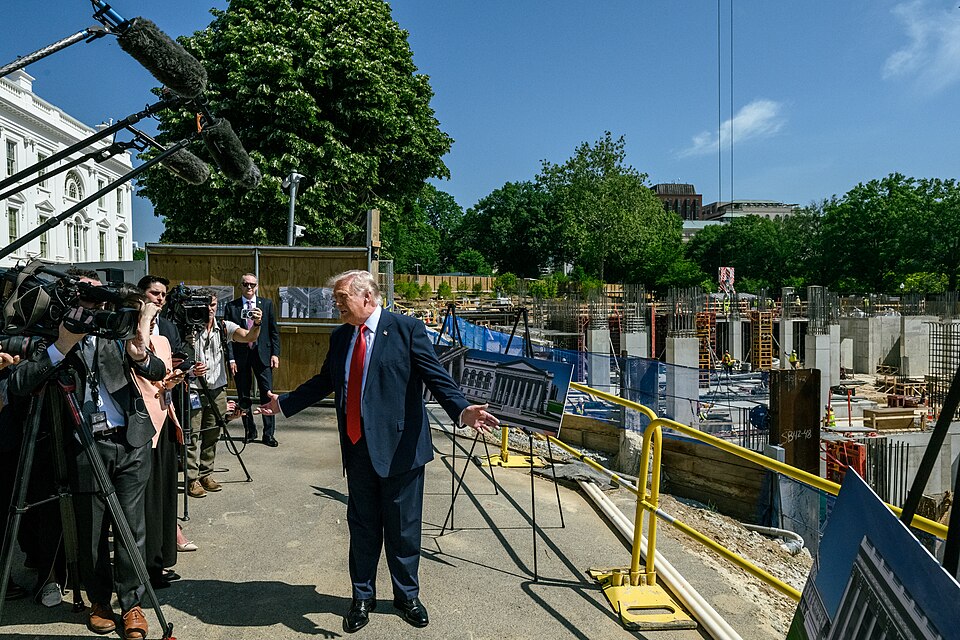
A federal appeals court ruled Friday that President Donald Trump cannot proceed with construction of a massive White House ballroom, affirming that Congress alone holds authority over changes to the executive mansion. Trump immediately vowed to appeal the decision to the Supreme Court, calling it a threat to national security.
Constitutional Authority at Center of Dispute
The U.S. Court of Appeals for the District of Columbia Circuit issued a 2-1 decision upholding a lower court’s modified preliminary injunction that blocks above-ground construction while permitting underground work to continue. The ruling emphasized that each president serves as a temporary tenant of the White House, not its owner, and cannot unilaterally alter the historic structure without congressional approval. The court stayed its decision for 14 days to allow the administration time to appeal.
Circuit Judges Patricia Millett and Brad Garcia wrote that the Constitution assigns Congress the responsibility to authorize physical changes to the White House, even when security concerns are cited. The judges noted they found no historical precedent for a president using privately collected funds to demolish substantial portions of the White House that Congress authorized and taxpayers funded.
Trump Demolished East Wing Without Congressional Permission
According to the court ruling, the Trump administration bulldozed the entire East Wing over three days in October 2025 without conducting promised consultations or obtaining congressional authorization. The planned project includes a 90,000 square-foot ballroom and an underground complex housing military and security facilities, all funded by private donations without congressional oversight.
Trump defended the project on social media, stating that military and Secret Service officials view the court’s decision as a national security threat. He argued the complex is essential for protecting Washington, D.C., and safeguarding future presidents, their families, visiting heads of state, and American citizens touring the executive mansion.
Historic Preservation Group Celebrates Victory
Brent Leggs, president of the National Trust for Historic Preservation, praised the ruling in a statement. His organization served as plaintiff in the case challenging the ballroom construction. Leggs emphasized that the White House represents a global landmark symbolizing American identity and democratic ideals that belongs to the American people, not any single administration.
Judge Neomi Rao, a Trump appointee, dissented from the majority opinion. She argued that the lower court abused its discretion by seizing control of construction at the president’s home and office. The appeals court clarified its ruling does not necessarily prevent the ballroom’s eventual construction but requires proper congressional authorization before work proceeds during ongoing litigation.
Then tear up Obama’s fucking basketball court… He was just a tenant as well. A shitty one…
Building a basketball court and tearing down a historical structure to put up some golden adorned ballroom is very different. The underground security seems reasonable but still should’ve gone through the proper process.
I don’t know what country you came from saturnian but orama boma is no BETTER THEN PRESIDENT TRUMP JUST BECAUSE HARRIS LOST TO A WHITE MAN THE WHITE HOUSE!! And it is still taxpayer property the tennis court!!!!
There wasn’t this much concern when Hillary tried to steal all the furniture out of the White House truckloads worth trying to cabinets and woven area rugs even the presidential toilet paper she wanted to steal everything
ok so now what? what are they going to build now? whatever gets built, it will probably be on our dime, and cost way more than the ballroom. did any other president get “permission” from congress for the changes they did to the white house? obarry built a basket ball court, how often has it been used. how much did that cost? to me the cost of either is irrelevant, yes I know both cost a lot to build, but to me it’s the principle of it all. one president does something extremely costly and stupid (imo such as the ugly overpriced library in chitcago) and everyone falls at his feet. and another president steals from us, and everyone seems to forget. then a president wants to build something for foreign dignitaries who visit and wants better security. oh but can’t have that. so now there’s a big hole , all construction has stopped. and if the left gets their way, tents will take the place of the ballroom. that’s so much better. baloney
The whole thing mick is that it is President Trump that is doing it and not a muslin,or slick willie , or hillabeast trying to steal furniture. THESE lying vengeful liberals will do anything to attack President Trump and protect their own lowlife party, just to get back at HIM!!!!!