
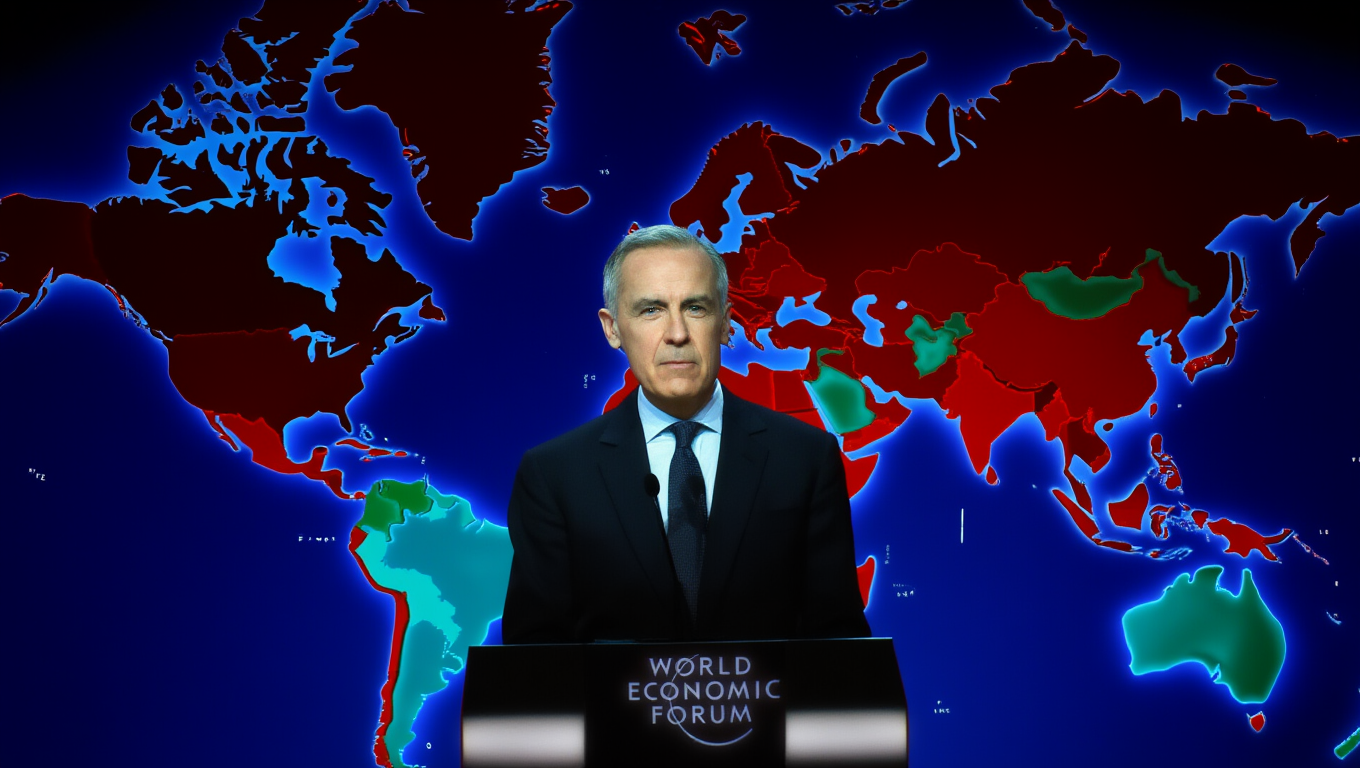
Canadian Prime Minister Mark Carney delivered a pointed address at the World Economic Forum in Davos on Tuesday, declaring that the established international order has permanently shifted and urging mid-tier nations to band together against what he characterized as economic bullying by major powers.
Speaking to the assembled global elite in Switzerland, Carney emphasized that smaller nations must unite strategically or risk becoming victims of great power competition. His remarks, while not explicitly naming President Donald Trump, appeared to directly address recent American threats regarding territorial expansion and economic coercion.
"We know the old order is not coming back. We shouldn't mourn it. Nostalgia is not a strategy. But we believe that from the fracture we can build something bigger, better, stronger, more just. This is the task of the middle powers," says PM Mark Carney in Davos speech.
#cdnpoli pic.twitter.com/ae9GLq4EdC— CPAC (@CPAC_TV) January 20, 2026
Middle Powers Under Pressure
Carney’s central thesis focused on the vulnerability of middle powers—nations like Canada, Australia, Brazil, and South Korea that wield significant regional influence but lack the military and economic dominance of UN Security Council permanent members. These countries, he argued, face an increasingly precarious position as global superpowers weaponize economic relationships.
“If we’re not at the table, we’re on the menu,” Carney stated, encapsulating the existential challenge facing nations caught between competing spheres of influence. This metaphor resonated with an audience acutely aware of how smaller economies can become collateral damage in trade wars and geopolitical maneuvering.
The Canadian leader’s assessment reflects a broader recognition among allied nations that traditional diplomatic norms and multilateral institutions may no longer provide adequate protection against unilateral action by major powers. His speech acknowledged that geography and historical alliances—long considered pillars of international stability—no longer guarantee security or economic prosperity.
Economic Warfare in the Modern Era
Carney painted a stark picture of contemporary international relations, describing the current moment as “a rupture, not a transition.” He outlined how great powers increasingly deploy economic tools as weapons, transforming previously neutral commercial relationships into instruments of coercion.
The prime minister specifically cited the weaponization of tariffs, financial infrastructure, and supply chain dependencies as evidence of this shift. This analysis directly parallels recent American actions, including the imposition of steep tariffs on Canadian goods and Trump’s repeated references to Canada as a potential “51st state.”
These economic pressures have intensified since Trump’s return to office, with the administration explicitly threatening to use “economic force” to achieve territorial and political objectives. The strategy represents a departure from traditional diplomatic engagement, favoring direct economic leverage over negotiated settlements.
Greenland and NATO Solidarity
Carney’s speech included a firm declaration of support for Greenland’s sovereignty and Denmark’s territorial rights, drawing sustained applause from the Davos audience. This position directly contradicts Trump’s increasingly aggressive campaign to acquire the Arctic territory, which has included social media posts depicting American flags over maps of Greenland, Canada, and the United States.
The Canadian leader reaffirmed his nation’s commitment to NATO’s Article 5 mutual defense clause, signaling that any military action against alliance members would trigger collective response obligations. This statement carries particular weight given recent reports that Canada is considering deploying troops to Greenland for joint military exercises with Danish and European forces.
Canadian Foreign Minister Anita Anand, also present in Davos, confirmed that Canada regularly participates in NATO exercises but declined to provide specific details about potential Greenland deployments. The measured response suggests Ottawa is carefully balancing deterrence with diplomatic restraint.
Strategic Realignment and New Partnerships
Rather than simply defending the status quo, Carney outlined Canada’s proactive approach to navigating the transformed geopolitical landscape. He described a strategy of building “different coalitions for different issues based on common values and interests,” suggesting a more flexible and pragmatic approach to international relations.
This strategy has already yielded concrete results, with Canada securing new trade and investment agreements with China and Qatar, as well as a defense procurement pact with the European Union. These partnerships demonstrate Ottawa’s effort to diversify relationships and reduce dependence on any single major power.
Carney positioned Canada as a “stable and reliable” partner for nations seeking alternatives to great power domination. This branding effort reflects recognition that middle powers must actively compete for influence and partnerships rather than assuming automatic inclusion in decision-making processes.
Implications for American Foreign Policy
The Canadian prime minister’s address represents a significant diplomatic challenge to American hegemony in North America and beyond. By publicly advocating for middle power coordination and explicitly rejecting territorial demands, Carney is essentially organizing resistance to Trump’s expansionist agenda.
This development could complicate American efforts to reshape regional power dynamics through economic pressure and territorial acquisition. If successful, Carney’s coalition-building approach might inspire similar resistance from other middle powers facing pressure from great power competitors.
The timing of Carney’s speech, delivered just one day before Trump’s scheduled Davos address, appears calculated to frame the debate around competing visions of international order. This direct confrontation suggests that traditional allies are prepared to publicly oppose American policies they view as threatening to sovereignty and international law.
Looking Ahead
Carney’s Davos intervention signals a potential turning point in how middle powers respond to great power competition. Rather than accepting subordinate status or choosing sides in bipolar conflicts, these nations appear increasingly willing to forge independent paths and mutual support networks.
The success of this approach will depend largely on whether middle powers can overcome historical divisions and competing interests to present unified positions on key issues. Early indicators, including Canada’s diverse partnership portfolio and NATO solidarity on Greenland, suggest momentum may be building for this alternative model.
As global leaders gather in Davos this week, Carney’s message represents more than Canadian foreign policy—it articulates a broader challenge to the assumption that smaller nations must simply adapt to great power preferences. The international community’s response to this challenge may well determine whether the emerging world order features genuine multipolarity or merely reshuffled dominance hierarchies.
Trump’s Wednesday address will likely provide insight into how the American administration views this middle power coordination effort and whether diplomatic engagement remains possible amid escalating territorial and economic disputes.
Trump must stop forging ahead with plans to provoke other countries. Status Quo has worked well. Impeach him if need be. We do not need his warlike attitude. Think peace not war
Well said!!