
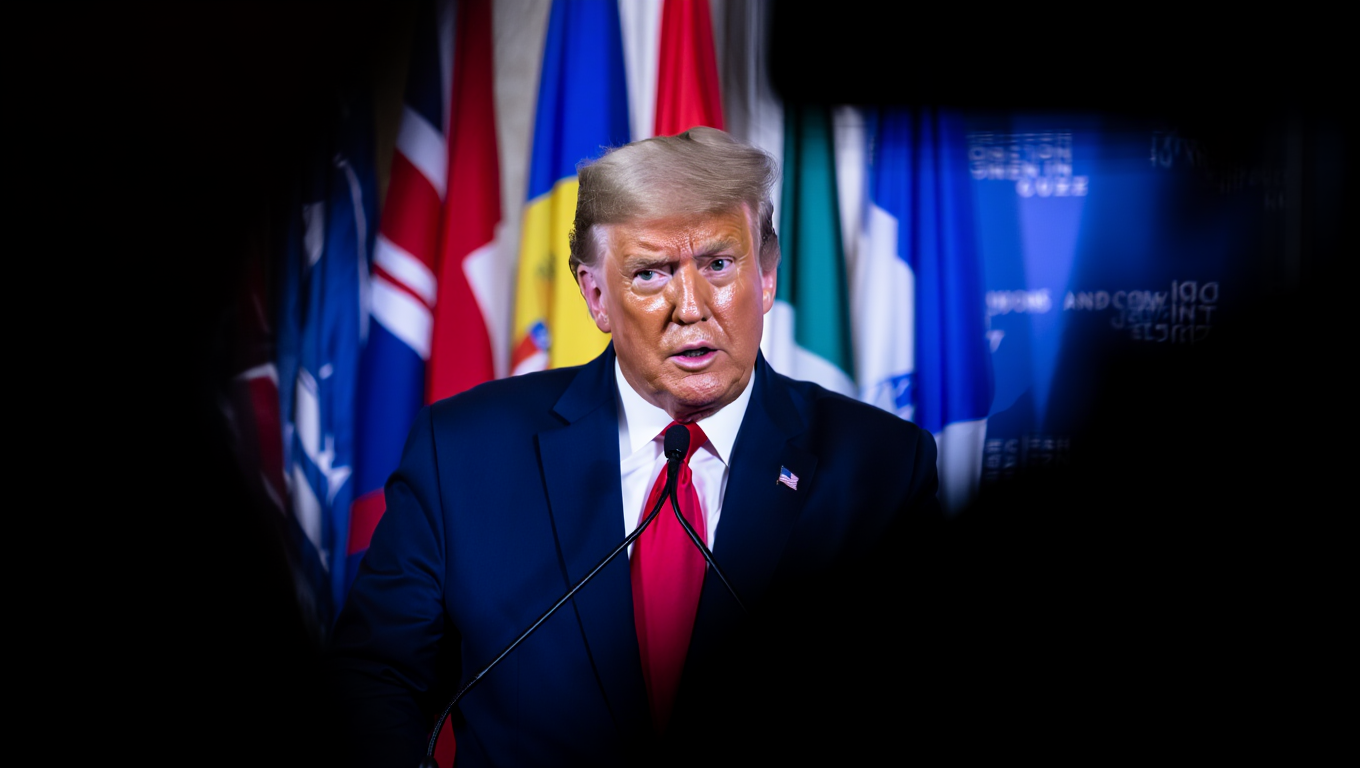
President Donald Trump announced Wednesday he would abandon his threatened tariffs against European allies over Greenland after reaching what he described as a “framework of a future deal” with NATO Secretary General Mark Rutte on Arctic security matters.
The reversal came just hours after Trump delivered provocative remarks at the World Economic Forum in Davos, Switzerland, where he had doubled down on his desire to acquire Greenland while simultaneously ruling out military force to achieve that goal.
Dramatic Policy Shift in Davos
Speaking to global leaders and business executives at the prestigious economic summit, Trump characterized his pursuit of the world’s largest island as a modest request given America’s historical contributions to European security. He described Greenland as “cold and poorly located” while arguing that U.S. control over the territory represented fair compensation for decades of military protection.
“It’s a very small ask compared to what we have given them for many, many decades,” Trump told the Davos audience, referencing America’s role in World War II and ongoing NATO commitments.
The president’s comments initially sent shockwaves through the transatlantic alliance, with many observers questioning whether Trump’s territorial ambitions could fracture the 77-year-old security partnership that has anchored Western defense strategy since the Cold War.
Military Force Ruled Out
Despite his aggressive rhetoric regarding Greenland acquisition, Trump explicitly rejected the use of military force during his Davos address. The president acknowledged that diplomatic efforts alone would likely prove insufficient but emphasized his reluctance to pursue more coercive measures.
“We probably won’t get anything unless I decide to use excessive strength and force, where we would be frankly unstoppable. But I won’t do that, OK?” Trump stated, adding moments later, “I don’t have to” and “I don’t want to use force.”
This declaration appeared designed to reassure European allies while maintaining pressure for eventual negotiations over Arctic security arrangements and territorial considerations.
Strategic Arctic Concerns Drive Policy
Trump’s renewed focus on Greenland reflects broader American concerns about great power competition in the Arctic region. The president has consistently argued that controlling Greenland would provide crucial strategic advantages in countering Russian and Chinese activities in Arctic waters.
The United States already maintains Thule Air Base in northern Greenland, one of the military’s northernmost installations and a key component of North American missile defense systems. However, Trump administration officials have suggested that formal territorial control would enhance America’s ability to project power and monitor rival nations’ Arctic operations.
Climate change has intensified great power competition in the Arctic as melting ice opens new shipping routes and exposes previously inaccessible natural resources. Both Russia and China have expanded their Arctic presence in recent years, prompting concerns among U.S. defense officials about potential threats to American interests.
NATO Framework Agreement Details Remain Unclear
While Trump announced reaching a framework agreement with NATO leadership, specific details about the arrangement remained undisclosed. The president’s description suggested the deal would address broader Arctic security concerns rather than immediate territorial transfers.
NATO Secretary General Mark Rutte met privately with Trump during the Davos proceedings, though neither leader provided comprehensive details about their discussions or the framework’s specific provisions. The agreement appears to represent a face-saving compromise that allows Trump to claim progress on his Greenland objectives while avoiding a direct confrontation with European allies.
The framework approach mirrors Trump’s negotiating style of making bold initial demands before settling for more modest agreements that can be portrayed as victories for all parties involved.
Danish and European Response
Danish officials have consistently maintained that Greenland is not for sale and cannot be separated from Denmark without the consent of both the Danish government and Greenlandic authorities. This position has received strong support from other European Union members and NATO allies.
"Based upon a very productive meeting that I have had with the Secretary General of NATO, Mark Rutte, we have formed the framework of a future deal with respect to Greenland and, in fact, the entire Arctic Region. This solution, if consummated, will be a great one for the United… pic.twitter.com/24b99begbb
— The White House (@WhiteHouse) January 21, 2026
Greenland, while geographically massive, has a population of only about 56,000 people and has been granted significant autonomy within the Kingdom of Denmark. The territory controls its own domestic affairs, while Denmark handles defense and foreign policy matters.
European leaders had expressed growing alarm about Trump’s territorial ambitions and threatened tariff measures, viewing them as unprecedented challenges to post-World War II international norms regarding territorial sovereignty.
Implications for Transatlantic Relations
The Greenland controversy represents one of the most significant tests of NATO unity since the alliance’s formation in 1949. Trump’s willingness to threaten economic measures against allies over territorial disputes marked a departure from traditional American diplomatic approaches.
However, the president’s decision to withdraw tariff threats and pursue a framework agreement suggests recognition that a full confrontation with European allies could undermine broader American strategic interests. NATO remains crucial for U.S. global military operations and intelligence-sharing arrangements.
The episode also highlights ongoing tensions over defense burden-sharing within the alliance, with Trump continuing to argue that European members should contribute more to collective security efforts.
Looking Ahead
The framework agreement’s success will likely depend on its ability to address American Arctic security concerns while respecting European positions on territorial sovereignty. Both sides appear motivated to find solutions that avoid a damaging alliance crisis.
Future negotiations will probably focus on enhanced military cooperation in Arctic regions, expanded intelligence sharing about Russian and Chinese activities, and potentially increased American access to Greenlandic facilities for defense purposes.
The compromise also demonstrates Trump’s continued use of pressure tactics in international negotiations, making dramatic initial demands before moderating positions to achieve more realistic outcomes. This approach has characterized his dealings with various international partners throughout his political career.
As the framework moves toward implementation, both American and European officials will need to balance competing domestic political pressures while maintaining alliance cohesion in an increasingly complex global security environment.