
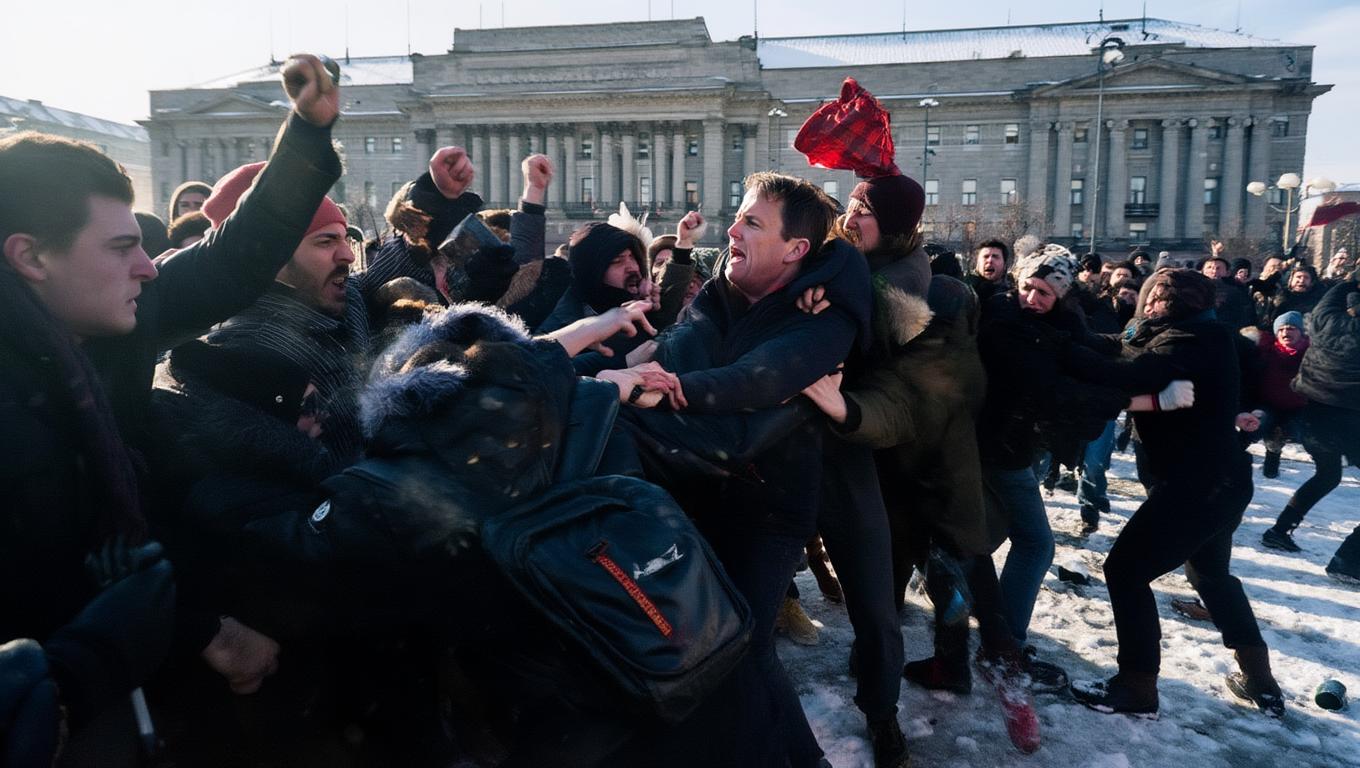
A planned demonstration supporting federal immigration enforcement operations in Minneapolis was effectively shut down Saturday when hundreds of counterprotesters confronted a small group of far-right activists near City Hall. The incident highlights growing tensions in Minnesota’s Twin Cities as federal immigration operations continue for their third week.
Conservative activist Jake Lang, who recently received clemency for his role in the January 6 Capitol attack, organized the pro-ICE rally that included anti-Islamic and anti-Somali messaging. Lang had announced on social media his intention to burn a Quran during the demonstration, though it remains unclear whether he followed through with that plan.
🚨 THIS WAS AN ATTEMPTED MURDER
After being beaten unconscious by a Democrat-aligned mob, Jake Lang was dragged back into the crowd — and STABBED.
Read that again.
They didn’t stop when he was down.
They didn’t walk away.
They tried to kill him.This is what happens when… pic.twitter.com/44tcTr69sw
— Jim Ferguson (@JimFergusonUK) January 18, 2026
The counterprotest drew several hundred participants who effectively drowned out Lang’s group through vocal opposition and physical confrontation. Video footage from the scene shows Lang appearing injured with visible bruises and scrapes on his head as he departed the area. At least one supporter was forced to remove clothing deemed offensive by the counterprotesters.
Federal Operations Spark Daily Protests
The Saturday confrontation represents the latest in a series of daily demonstrations that have occurred since early January, when the Department of Homeland Security deployed more than 2,000 federal officers to the Minneapolis-St. Paul metropolitan area. The enhanced immigration enforcement operation has generated significant controversy in the traditionally liberal region.
Local residents and activists have criticized what they describe as aggressive tactics by masked federal agents, including forced entries into homes and vehicle stops. The operations have resulted in numerous arrests and at least one fatality. On January 7, Renee Good, a U.S. citizen and mother of three children, was fatally shot by an ICE officer during a confrontation.
Protester Luke Rimington articulated the sentiment driving the counterdemonstrations, stating the goal was to demonstrate that “Nazis and ICE and DHS” are unwelcome in Minneapolis. The comment reflects the broader opposition movement’s framing of federal immigration enforcement as an unwelcome intrusion into local communities.
Neo Nazi Jake Lang screams about the need for a race war into a megaphone, then gets saved from a mob of white people by a Black man.
You can’t make this up.
— Micah (@micah_erfan) January 18, 2026
State and Local Government Response
Minnesota Governor Tim Walz, a Democrat and frequent critic of the Trump administration, has mobilized the state’s National Guard to support law enforcement operations. According to Guard spokesperson Major Andrea Tsuchiya, units have been positioned and prepared for deployment but have not yet been activated for field operations.
The Guard’s stated mission includes providing traffic support and protecting the rights of all Minnesota residents to assemble peacefully. This mobilization follows Walz’s earlier directive for Guard units to prepare for potential law enforcement support as federal operations intensified.
Minneapolis Mayor Jacob Frey has been particularly vocal in his opposition to federal operations, describing the situation as an “invasion by our own government” during a Sunday appearance on CNN’s State of the Union program. Frey also indicated that deploying the 1,500 active-duty Army soldiers currently on standby would be unconstitutional.
Legal Developments and Individual Cases
Federal courts have begun imposing restrictions on immigration enforcement operations amid the protests. On Friday, a federal judge issued a ruling prohibiting immigration officers from detaining or using tear gas against peaceful protesters who are not obstructing official duties. This includes individuals observing enforcement actions.
The case of Garrison Gibson has become a focal point for opposition activists. The 38-year-old refugee from Liberia’s civil war was arrested at his Minneapolis home on January 11 when federal officers used a battering ram to break down his front door. Video of the arrest has circulated widely among protest organizers.
Jake Lang’s life was saved by an African-American man and he was treated by a Somali-American nurse, a stark reminder that humanity and professionalism rise above racism, even when hatred does not. pic.twitter.com/Xv2aHAfJ9i
— Farah Abdirahman (@faaraxyare) January 18, 2026
Gibson faces deportation orders apparently stemming from a 2008 drug conviction that was subsequently dismissed. He had been living legally in the United States under an order of supervision before his recent arrest. Following his detention, Gibson expressed fear about leaving his home and concerns about ongoing enforcement operations in his community.
Broader Context of Immigration Enforcement
The Minneapolis operations represent part of a broader expansion of immigration enforcement under the Trump administration’s second term. The deployment of thousands of federal officers to a single metropolitan area represents a significant escalation in enforcement tactics compared to typical ICE operations.
The choice of Minneapolis-St. Paul as a focus area is notable given the region’s large Somali immigrant population and historically liberal political orientation. The area has been a frequent target of criticism from conservative politicians and activists who oppose refugee resettlement programs.
Jake Lang’s background adds another dimension to the tensions. Lang received clemency as part of President Trump’s sweeping pardons for January 6 participants at the beginning of his second presidency. Lang had faced charges including assaulting an officer with a baseball bat and civil disorder before receiving clemency. He has since announced a Senate campaign in Florida.
Community Impact and Ongoing Tensions
The daily protests and federal operations have created a climate of tension in Minneapolis neighborhoods with significant immigrant populations. Community organizations report increased fear among residents, with many avoiding normal activities due to concerns about enforcement actions.
Local businesses and schools have also reported disruptions as protests and enforcement operations affect transportation and daily routines. The presence of heavily armed federal officers in residential neighborhoods has generated particular concern among community advocates.
The confrontation between protesters and federal agents has occasionally turned violent, with reports of projectiles, including snowballs and water balloons, being thrown before police in armored vehicles arrived to separate opposing groups.
As federal operations continue into their third week, both supporters and opponents of enhanced immigration enforcement appear to be organizing for sustained confrontation. The daily protest cycle shows little sign of diminishing, while federal officials have indicated their operations will continue until objectives are met.
The situation in Minneapolis reflects broader national divisions over immigration policy and federal enforcement priorities. The intense local opposition demonstrates how national policy debates play out differently in communities with varying demographic compositions and political orientations.