
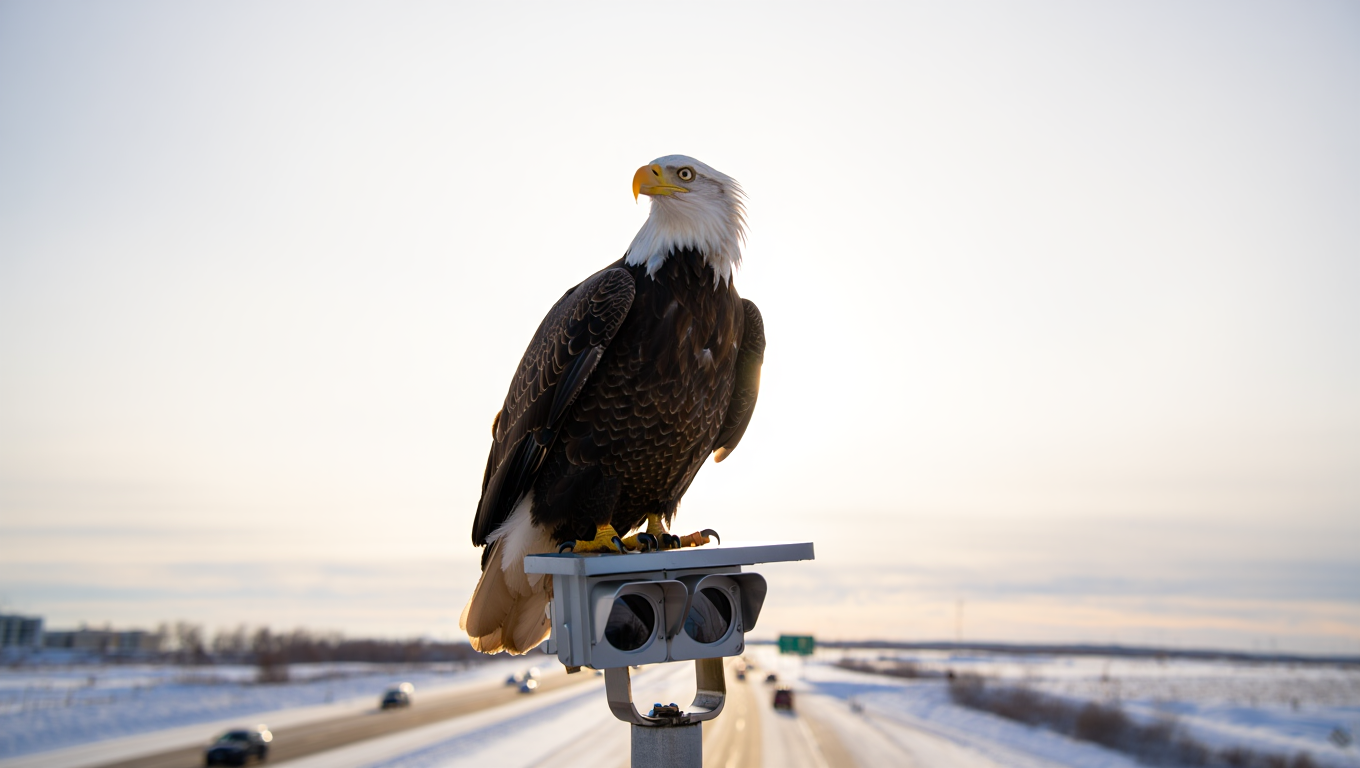
A routine traffic monitoring system in Minneapolis delivered an unexpected wildlife sighting this week when a bald eagle was spotted using highway infrastructure as its personal observation post. The majestic bird appeared on Minnesota Department of Transportation cameras positioned along Interstate 35, creating a striking image that quickly gained attention across social media platforms.
The footage, released by state transportation officials on Thursday, shows the adult bald eagle maintaining a steady perch on highway railings while vehicles navigate the snow-covered roadway below. The bird’s positioning suggests it was actively surveying the area, leading transportation officials to playfully dub it their newest “eagle-eyed traffic reporter.”
JUST IN: 🇺🇸 Bald eagle spotted on a Minnesota traffic camera. pic.twitter.com/UNeHfSL2gN
— Remarks (@remarks) January 23, 2026
Wildlife Adaptation in Urban Infrastructure
The sighting represents a growing trend of bald eagles adapting to urban environments and utilizing human-made structures for hunting and observation purposes. Wildlife biologists note that highway overpasses and traffic infrastructure often provide elevated vantage points that eagles find advantageous for spotting potential prey and monitoring territory.
Minnesota’s bald eagle population has experienced a remarkable recovery over recent decades. The state now hosts one of the largest breeding populations in the continental United States, with over 1,300 breeding pairs documented in recent surveys. This population growth has led to increased interactions between eagles and urban infrastructure, particularly during winter months when food sources become more concentrated along waterways and roadways.
The Interstate 35 corridor, where this eagle was photographed, runs through the Twin Cities metropolitan area, providing a wildlife corridor that connects various habitats. Eagles often follow river systems, and I-35 parallels the Mississippi River through much of the Minneapolis-St. Paul region, creating natural pathways for these large raptors.
— Agent Peters, CEA (@agentpeterscea) January 23, 2026
Surviving Extreme Winter Conditions
The timing of this sighting coincides with some of the harshest winter weather conditions Minnesota has experienced this season. Weather forecasters predict wind chill temperatures could plummet to minus 50 degrees Fahrenheit across the Minneapolis metropolitan area this weekend, creating potentially life-threatening conditions for both humans and wildlife.
Bald eagles possess remarkable physiological adaptations that enable them to survive these extreme conditions. Their bodies are covered with approximately 7,000 individual feathers arranged in multiple layers that create an incredibly efficient insulation system. The outer layer consists of contour feathers that provide waterproofing and wind resistance, while the inner down feathers trap warm air close to the bird’s body.
Research conducted by the University of Minnesota’s Raptor Center has documented how bald eagles regulate their body temperature through behavioral and physiological mechanisms. During extreme cold, eagles can reduce blood flow to their extremities while maintaining core body temperature. They also utilize a counter-current heat exchange system in their legs and feet, allowing them to stand on frozen surfaces without losing significant body heat.
Traffic Cameras as Wildlife Monitoring Tools
This incident highlights an unexpected benefit of extensive traffic monitoring infrastructure. Transportation departments across the United States maintain thousands of cameras for traffic management purposes, but these systems increasingly capture valuable wildlife behavior data.
The Minnesota Department of Transportation operates over 500 traffic cameras statewide, providing continuous monitoring of road conditions and traffic flow. While their primary function focuses on transportation safety and efficiency, these cameras have documented various wildlife species, from deer crossings to bird migration patterns.
Make Minnesota Great Again. 💞 pic.twitter.com/faXPWu7yny
— Karine / كارينا ✝️🇧🇻❤️🇵🇸 (@karineisback) January 23, 2026
Wildlife researchers have begun collaborating with transportation agencies to utilize this existing camera network for conservation purposes. The continuous monitoring capability provides insights into animal behavior patterns, migration routes, and habitat usage that would be difficult and expensive to obtain through traditional wildlife research methods.
Conservation Success Story
The presence of bald eagles in urban Minnesota environments represents one of America’s most significant conservation success stories. These birds faced near-extinction in the lower 48 states during the mid-20th century, with populations declining to fewer than 500 breeding pairs by the 1960s.
The primary causes of this decline included habitat destruction, hunting pressure, and widespread use of DDT pesticide, which caused eggshell thinning and reproductive failure. Federal protection under the Endangered Species Act, combined with DDT bans and intensive management efforts, enabled population recovery.
Minnesota played a crucial role in bald eagle conservation efforts. The state maintained one of the few stable breeding populations during the species’ lowest point and served as a source population for reintroduction efforts in other states. Today, Minnesota’s eagle population continues growing, with birds expanding into previously unoccupied habitats, including urban and suburban areas.
Public Safety Considerations
While wildlife sightings generate public excitement, transportation officials emphasize the importance of driver safety when eagles or other large birds are present near roadways. Bald eagles have wingspans reaching eight feet and can create hazardous conditions if they enter traffic lanes.
The Minnesota Department of Transportation advises drivers to maintain focus on road conditions rather than attempting to observe wildlife while driving. Eagles and other large birds can appear suddenly, particularly during winter months when they concentrate near open water sources that may be adjacent to highway corridors.
Vehicle strikes represent a significant mortality factor for bald eagles, particularly along major highway corridors. Transportation agencies have implemented various wildlife crossing structures and deterrent systems in high-risk areas to reduce these interactions.
Seasonal Behavior Patterns
Winter eagle sightings in urban areas typically increase due to several factors. Many northern eagles migrate south during extreme weather, concentrating populations in areas with reliable food sources and open water. The Twin Cities region maintains numerous areas of open water due to industrial discharge and urban heat effects, attracting wintering eagles.
Eagles also modify their hunting strategies during winter months, often scavenging roadkill and concentrating near areas with predictable food sources. Highway corridors can provide both carrion opportunities and elevated perching sites for hunting waterfowl along nearby rivers and lakes.
The bird captured in Thursday’s traffic camera footage likely represents this typical winter behavior pattern. Its positioning above the interstate suggests active hunting behavior, as eagles often use elevated perches to scan for opportunities before expending energy on hunting flights.
This remarkable wildlife encounter serves as a reminder of nature’s adaptability and the ongoing success of conservation efforts that have restored America’s national bird to landscapes across the country, even in the most unexpected urban settings.